Appointment Setting Services

Scaling for Rapid Growth
Whether you are growth hacking at an early-stage startup or scaling in enterprise tech, our outsourced sales specialists scale and advance your sales pipeline quickly and predictably with a rapid infusion of qualified appointments. We deliver the boost you need to exceed your sales goals and improve the productivity of your internal sales team.
Each Year for Our Appointment Setting Clients, We Generate More Than:
Campaigns
Appointments
Million in Pipeline
How Our B2B Appointment Setting Partnerships Work

Agree
We work with you to create a partnership that ensures strategic alignment with your goals.

Kickoff
We design a custom campaign, then select the best SDRs from our team for the project.

Implement
Our experienced team ramps up quickly and starts setting appointments with quality leads.

Handoff
As we book appointments, we deliver warm, seamless handoffs of qualified leads to your team.

Check-in
We facilitate regular reviews of campaign progress to maintain transparency and alignment.

RIVERBED TECHNOLOGIES
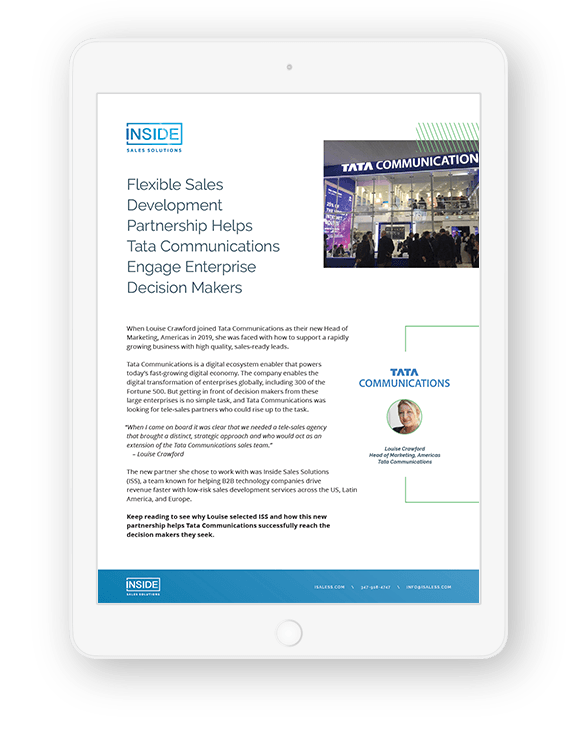
Case Study: Creating a Pipeline for an Industry Leader in Cybersecurity Software
See how strategic cold calling services established an industry leader as a mainstay competitor and innovator in their market.

Only Pay for Kept Appointments
We’ll secure appointments with qualified decision-makers for you, guaranteed. You only pay when you speak with your prospect, not when we book the appointment.
If a prospect does happen to cancel, we’ll handle rescheduling or replacing that meeting with someone new.

Scale Up or Down
The purpose of our appointment setting services is to support your growth. Once we’ve dialed in our approach, we can turn that dial in any direction. We can turn it up for high-velocity or dial it back if you’re busy. And we can pivot to enable you to try something new. Whatever your need, our approach is to deliver continuous, reliable B2B appointments with your target decision makers.

Quality Leads, Seamless Handoffs
We launch every project by aligning with your team’s process and culture. This ensures our reps have the product and service context to speak like your reps. This synchronicity, combined with our broad B2B Tech expertise, ensures we successfully engage leads with the accurate persona and level of authority.
Once leads are engaged, we provide warm, seamless handoffs eliminating any unnecessary friction for you or the prospect. You’ll also get access to a personalized client portal to view leads and notes at any time.
Our Clients




















Level-Up Your Sales Strategy with Appointment Setting Services
Book a free consultation with our VP of Global Sales to learn more about partnering with ISS to fill and advance your pipeline.
FAQs
Q1: How does ISS appointment setting work?
ISS runs a phone-first outreach program that puts BANT-qualified meetings on your sales team’s calendar – and then joins the discovery call to hand off the prospect live. The process starts with ISS SDRs dialing a proprietary database of 55,000+ human-verified mobile numbers for IT decision-makers, targeting accounts that match your ICP.
Every contact goes through BANT qualification: Budget, Authority, Need, and Timeline. If a prospect doesn’t clear all four, they don’t become an appointment. No filler meetings, no “exploratory conversations” with contacts who just happened to pick up the phone.
What separates ISS from standard appointment setting is what happens at the meeting itself. Their SDR joins the discovery call, recaps the previous conversation with the prospect, and introduces your AE live – a model they call the Concierge Handoff. Your rep walks into every call with context already established, not cold.
After each meeting, ISS provides a post-meeting survey and client portal access so you can track quality, flag issues, and monitor pipeline health in real time – no waiting for a monthly report to find out what happened.
Q2: What is ISS’s concierge live handoff?
What Is the Concierge Live Handoff Process?
The Concierge Live Handoff is ISS’s practice of having the SDR join every discovery call, recap the prior conversation with the prospect, and introduce your account executive in real time. No other outsourced SDR company does this consistently.
Most appointment-setting firms hand off a calendar invite and consider the job done. The problem: your AE joins a call with a prospect who barely remembers the original conversation. That dead air kills deals before they start.
ISS’s handoff model solves this directly. The SDR who made the connection stays engaged through the opening of the discovery call – recapping what the prospect said they cared about, confirming timing, and making a warm introduction. Your AE starts from a position of credibility, not confusion.
For enterprise sales cycles where first impressions carry real weight, this distinction matters. ISS built the Concierge Handoff because they were watching qualified meetings fall flat at the handoff stage, and they fixed it. It’s now one of the clearest operational differences between ISS and competitors like memoryBlue, CIENCE, or SalesRoads – none of which offer this as a standard part of their service.
Q3: How does pay-for-performance SDR pricing work?
With ISS’s pay-for-performance model, you pay per qualified meeting delivered rather than a flat monthly retainer. The standard engagement targets five BANT-qualified meetings per week at roughly 20 hours of SDR time – and you’re only charged when meetings actually happen.
This stands in contrast to the dedicated retainer model, which over 80% of outsourced SDR firms use exclusively. Retainer models charge you whether appointments get booked or not, which front-loads the risk onto you. Pay-for-performance flips that dynamic.
For companies evaluating outsourced sales development for the first time – or those burned by a retainer engagement that produced thin results – the pay-per-meeting model is a lower-risk entry point. You get to see ISS’s quality without committing to a full dedicated SDR arrangement.
The trade-off: pay-for-performance works best when your target market is clearly defined and your ICP is tightly scoped. If your targeting is broad or your technology is obscure, ISS will tell you that upfront – it’s part of their qualification process before any engagement starts.
Q4: What counts as a qualified appointment at ISS?
How ISS Defines a Qualified Sales Meeting
Every appointment ISS delivers must pass BANT criteria: the prospect has confirmed Budget, Authority, Need, and Timeline. If a meeting doesn’t clear all four, it doesn’t count – and under the pay-for-performance model, you don’t pay for it.
BANT qualification sounds basic, but most appointment setting vendors don’t enforce it strictly. They’ll book “exploratory conversations” with contacts who have a title match and showed mild interest on a call. Those meetings waste your AE’s time and erode confidence in the entire program.
ISS SDRs are trained to probe all four criteria before locking a meeting. That means asking about budget directly, confirming the contact has decision-making authority or significant influence, establishing that a real need exists, and getting a clear sense of timeline. Prospects who are too early-stage go into a nurture cadence, not your calendar.
The result is a meeting your AE can actually run productively – with a prospect who knows why they’re on the call, what they’re evaluating, and when they need to make a decision.
Q5: How does ISS reach IT decision-makers so effectively?
ISS uses a proprietary database of 55,000+ human-verified mobile numbers for IT decision-makers – built and maintained over 14 years of active outreach. That’s not a licensed data append. Those are numbers their SDRs have confirmed through direct conversation, with 14 years of engagement notes attached.
Phone is the primary channel. ISS SDRs average 300 calls per day, and phone drives about 85% of their results. Email reply rates in B2B tech have dropped below 1%, which means automated email sequences – the default for most SDR agencies — are largely background noise for the IT buyers ISS targets.
Mobile numbers matter specifically because IT decision-makers don’t sit at desk phones. Getting to a CISO, VP of Infrastructure, or IT Director means calling them where they actually pick up. The 55,000+ mobile contacts in ISS’s database represent 14 years of call dispositions, relationship history, and real engagement context – something no purchased list provides.
This is a tangible operational advantage over competitors like CIENCE, which leads with a data platform, or Martal Group, which relies on AI-driven sequencing. ISS leads with the phone because it works.
Q6: Which industries does ISS serve for appointment setting?
What Industries Does ISS Serve for Outreach?
ISS focuses almost exclusively on B2B technology: cybersecurity, Big Data, networking, IT services, and B2B SaaS make up roughly 95% of their client base. They’ve spent 14+ years building pipeline for companies like Cisco, IBM, and Palo Alto Networks.
That specialization isn’t a marketing claim. It means their SDRs already know what a CISO cares about, how a VP of Infrastructure evaluates vendors, and what objections surface in enterprise networking deals. They don’t need a long ramp to understand the space – they’ve been working it for over a decade.
ISS is expanding into healthcare technology, medical devices, and financial software – adjacent verticals where the sales motion looks similar: long cycles, technical buyers, and deal sizes above $15K.
The flip side: ISS isn’t the right fit for every company. If you’re selling a product with a very small total addressable market (fewer than 300 target accounts), a “nice to have” technology with no urgency, or targeting personas like HR where phone outreach rarely lands, ISS will tell you that before you sign. The pay-for-performance model only works when there’s a real, reachable market to dial into.
Q7: How fast can ISS start booking sales meetings?
Most ISS engagements begin producing meetings within the first two to three weeks of launch, with full ramp typically complete within the first month. The exact timeline depends on how quickly your team completes onboarding – messaging alignment, ICP definition, and CRM access for Dedicated SDR engagements.
ISS has 14+ years of engagement notes in their CRM and 55,000+ verified mobile numbers already loaded for common B2B tech personas. SDRs aren’t starting from zero on day one. For clients in cybersecurity, networking, or enterprise SaaS, many of the target contacts are already in ISS’s system with prior touchpoints logged.
The pay-for-performance model tends to produce first meetings faster because the scope is tighter: defined ICP, five target meetings per week, narrow focus. Dedicated SDR engagements take slightly longer to ramp because the SDR is also being integrated into your systems and learning the nuances of your sales process.
If you’re under pressure to show pipeline quickly – ahead of a board review, a funding close, or a product launch – ISS’s existing infrastructure makes them faster to productive output than building an internal SDR function from scratch.
Q8: How does ISS compare to other appointment-setting firms?
ISS stands apart from competitors on two specific points: pay-for-performance pricing and the Concierge Live Handoff. Most SDR agencies – including memoryBlue, CIENCE, and SalesRoads – offer dedicated retainer models only and consider the job done at the calendar invite.
memoryBlue is strong on SDR training and talent development but runs exclusively on retainer pricing. CIENCE has built a solid data platform but leans offshore and leads with tech-first sequencing over phone. Martal Group covers a broader range of industries using AI-assisted prospecting, without the deep B2B tech specialization ISS has built over 14 years. SalesRoads specializes in appointment setting but comes in at a higher cost without a pay-per-performance option.
ISS’s ideal client is a B2B tech company that’s already serious about pipeline: average deal sizes above $15K, sales cycles of three months or more, and a sales team that needs qualified opportunities they can actually close. Companies running multi-agency strategies often add ISS specifically for their phone-first methodology, which complements email and digital demand gen rather than duplicating it.
The pay-for-performance option is the most direct way to evaluate ISS without retainer risk. Five target meetings per week gives you enough volume to assess quality within the first 30 to 60 days.